
Introduction
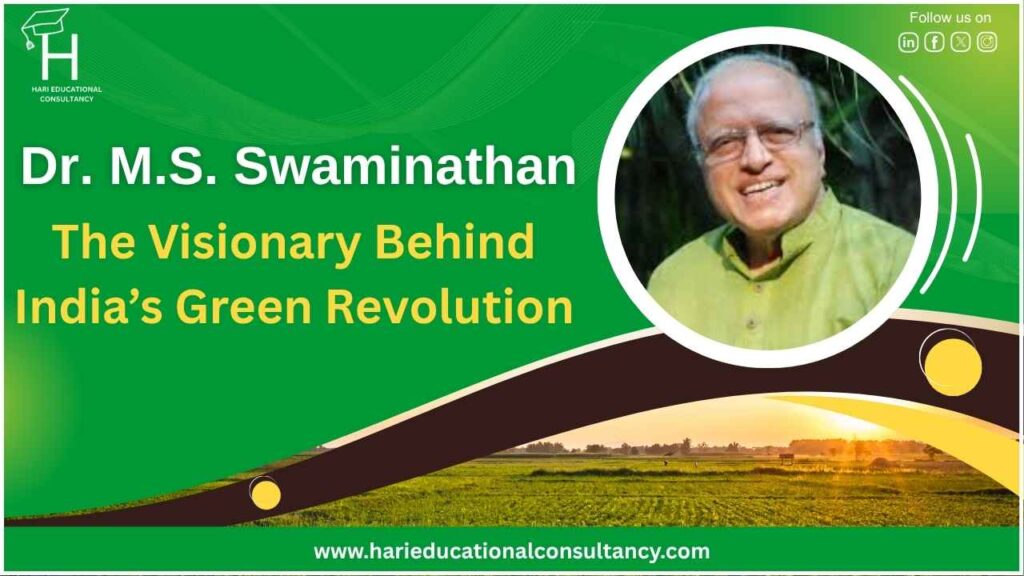
India owes much of its agricultural prosperity to one extraordinary scientist — Dr. Mankombu Sambasivan Swaminathan. Born on August 7, 1925, Dr. Swaminathan is globally recognized as the Father of India’s Green Revolution, a title he earned through groundbreaking work that turned India from a food-deficient nation into one of the world’s largest agricultural producers.
At Hari Educational Consultancy, we believe in celebrating those who inspire change through education, research, and innovation. Dr. Swaminathan’s legacy is a testament to the transformative power of knowledge.
His Early Life and Education
Dr. Swaminathan pursued a career in agricultural sciences at a time when most students opted for medicine or engineering. After earning his degree in agricultural science from the University of Madras, he continued higher studies at the Indian Agricultural Research Institute (IARI) and furthered his research in plant genetics in the Netherlands and the United States.
His strong academic foundation laid the groundwork for innovations that would shape India’s food systems for generations.
The Green Revolution in India
In the 1960s, India was grappling with food shortages and widespread hunger. Dr. Swaminathan, through strategic research and collaboration, introduced high-yielding varieties (HYVs) of wheat and rice that dramatically boosted food production. These changes were not just scientific; they were deeply social and economic in impact.
By helping Indian farmers increase crop output, Dr. Swaminathan played a central role in ensuring national food security and rural empowerment.
Key Contributions
🔬 Development of High-Yield Crops
📈 Enhancement of Farmer Productivity
🌿 Promotion of Sustainable Agricultural Practices
🌎 Global Advocacy for Food Security and Ecological Balance
He also played a key role in establishing research institutions such as the MS Swaminathan Research Foundation (MSSRF), which continues to focus on sustainable rural development and climate-resilient agriculture.
Awards and Global Recognition
Dr. Swaminathan has been honored with numerous national and international awards, including:
- Padma Shri (1967)
- Padma Bhushan (1972)
- Padma Vibhushan (1989)
- World Food Prize (1987)
- UNESCO Mahatma Gandhi Prize (2000)
He was also nominated as one of the Time magazine’s 20 most influential Asians of the 20th century.
His Legacy in Education and Research
Dr. Swaminathan was a strong advocate of science-led development. His belief in the power of education, research, and mentorship continues to influence India’s academic and agricultural policy.
He inspired thousands of students and researchers to pursue careers in agriculture, environmental science, and rural development — fields that remain vital to India’s future.
Why Students Should Know His Story
At Hari Educational Consultancy, we encourage students to draw inspiration from pioneers like Dr. Swaminathan. His life story is not just about agricultural science — it’s about vision, determination, and the courage to create lasting change.
Whether you aim to study agricultural science, environmental studies, or public policy, his journey shows how education can solve real-world problems.
Conclusion
Dr. M.S. Swaminathan’s contributions have permanently shaped India’s path to food security and sustainable development. As we honor his birth anniversary, we remember not just his scientific achievements, but his enduring message: use knowledge for the betterment of humanity.
Let his legacy inspire you to pursue a future that combines innovation with compassion.