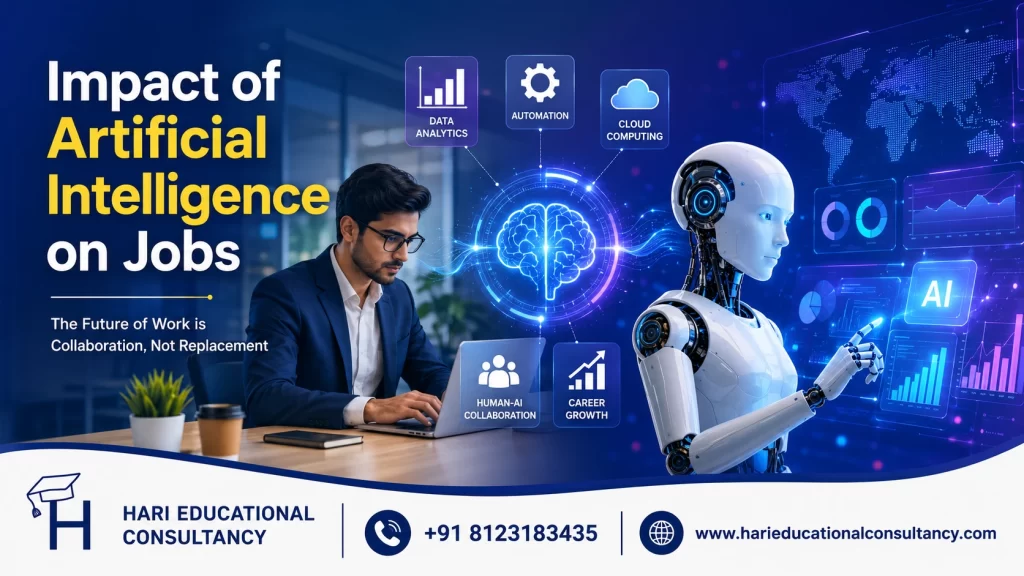
Artificial Intelligence (AI) is no longer a futuristic concept. Instead, it has become an essential part of modern workplaces, businesses, and industries. From automated customer service to advanced healthcare diagnostics, AI is transforming how work is performed across the globe.
As AI technologies continue to evolve, many people are asking an important question: Will AI replace jobs or create new opportunities? The answer is more complex than a simple yes or no. While some traditional roles are being automated, countless new career opportunities are also emerging.
In this blog, we will explore the impact of artificial intelligence on jobs, the industries most affected, future career trends, and how individuals can prepare for an AI-powered future.
Understanding Artificial Intelligence in the Workplace
Artificial Intelligence refers to computer systems designed to perform tasks that normally require human intelligence. These tasks include:
- Problem-solving
- Data analysis
- Decision-making
- Language processing
- Image recognition
- Predictive forecasting
As a result, businesses are increasingly adopting AI tools to improve efficiency, reduce costs, and enhance customer experiences.
How AI Is Changing Jobs Today
AI is already transforming workplaces in several ways. Consequently, organizations are redesigning job roles and introducing new working models.
Automation of Repetitive Tasks
Many repetitive and rule-based tasks can now be handled by AI systems. For example:
- Data entry
- Invoice processing
- Appointment scheduling
- Inventory management
- Customer support chatbots
Because of this automation, employees can focus on more strategic and creative responsibilities.
Enhanced Decision-Making
AI systems can analyze large amounts of data within seconds. Therefore, businesses can make faster and more accurate decisions.
Industries such as finance, healthcare, and logistics are benefiting significantly from AI-powered insights.
Increased Productivity
AI-powered tools help employees complete tasks more efficiently. As a result, productivity levels have improved across multiple sectors.
For instance, AI writing assistants, coding tools, and virtual assistants enable professionals to accomplish more work in less time.
Jobs Most Likely to Be Affected by AI
Certain occupations are more vulnerable to automation because they involve repetitive and predictable tasks.
These include:
- Data entry clerks
- Telemarketers
- Basic accounting assistants
- Administrative support roles
- Routine manufacturing positions
However, this does not necessarily mean these jobs will disappear entirely. Instead, many roles will evolve and require employees to work alongside AI technologies.
Jobs That Are Expected to Grow Because of AI
Interestingly, AI is also creating entirely new career opportunities.
Some high-demand AI-related careers include:
AI Engineer
AI engineers develop intelligent systems and machine-learning models that solve real-world problems.
Data Scientist
Data scientists analyze complex datasets to help organizations make informed decisions.
Machine Learning Specialist
These professionals design algorithms that enable machines to learn and improve over time.
AI Ethics Consultant
As AI becomes more powerful, ethical concerns are increasing. Therefore, organizations need experts to ensure responsible AI usage.
Cybersecurity Analyst
AI-driven technologies require strong security measures. Consequently, cybersecurity professionals remain in high demand.
Human-AI Collaboration Manager
Future workplaces may require specialists who manage interactions between employees and AI systems.
The Future of Jobs: A Prediction for the Coming Decade
Looking ahead, the future of work will likely be shaped by collaboration rather than competition between humans and AI.
Human Skills Will Become More Valuable
While AI can process information quickly, it cannot fully replicate uniquely human qualities such as:
- Creativity
- Emotional intelligence
- Leadership
- Critical thinking
- Relationship building
Therefore, individuals who develop these skills may enjoy greater career stability.
Hybrid Workforces Will Become Common
Organizations are expected to create hybrid teams consisting of both human employees and AI systems.
Employees will increasingly use AI as a workplace assistant rather than viewing it as a replacement.
Lifelong Learning Will Be Essential
The rapid pace of technological change means workers must continuously update their skills.
As a result, professional development and upskilling will become more important than ever before.
Personalized Careers Will Emerge
AI may help individuals identify strengths, career paths, and learning opportunities tailored to their unique abilities.
Consequently, career planning could become more personalized and effective.
Industries That Will Experience Major AI Transformation
Several sectors are expected to undergo significant changes due to AI adoption.
Healthcare
AI can assist doctors with diagnostics, treatment recommendations, and patient monitoring.
Education
Personalized learning platforms powered by AI can improve student outcomes and engagement.
Finance
Banks and financial institutions use AI for fraud detection, risk assessment, and investment analysis.
Manufacturing
Smart factories are increasingly utilizing AI-driven automation and predictive maintenance systems.
Transportation
Autonomous vehicles and intelligent traffic management systems may redefine transportation in the future.
How Students and Professionals Can Prepare for an AI-Driven Future
To remain competitive in the evolving job market, individuals should focus on developing future-ready skills.
Consider the following strategies:
- Learn AI fundamentals
- Develop digital literacy
- Improve communication skills
- Strengthen critical thinking abilities
- Gain experience with AI-powered tools
- Pursue continuous learning opportunities
- Build adaptability and resilience
Most importantly, embrace technology rather than fear it.
Final Thoughts
Artificial Intelligence is reshaping the global workforce at an unprecedented pace. Although certain jobs may be automated, many new opportunities are also being created. The future belongs to individuals who can adapt, learn continuously, and effectively collaborate with intelligent technologies.
Rather than replacing humans entirely, AI is expected to augment human capabilities and transform how work is performed. Therefore, those who invest in future-ready skills today will be better positioned to thrive in tomorrow’s job market.
The most successful professionals of the future may not be those who compete against AI, but those who learn how to work alongside it.
📞 Contact us today: +91 8123183435
🔗 Visit: www.harieducationalconsultancy.com
Frequently Asked Questions
1. Will artificial intelligence replace all jobs?
No. While AI may automate certain repetitive tasks, many jobs will continue to require human creativity, judgment, and emotional intelligence.
2. Which jobs are safest from AI automation?
Careers involving leadership, creativity, healthcare, education, counseling, and strategic decision-making are generally less vulnerable to automation.
3. What new jobs is AI creating?
AI is creating roles such as AI engineers, machine learning specialists, data scientists, AI ethics consultants, and AI product managers.
4. How can students prepare for an AI-driven future?
Students should focus on digital skills, critical thinking, communication, adaptability, and continuous learning to remain competitive.
5. Is AI a threat or an opportunity?
AI can be both. However, for individuals willing to learn new skills and adapt, it presents significant opportunities for career growth and innovation.
6. What is the impact of artificial intelligence on jobs in the future?
The impact of artificial intelligence on jobs is expected to be significant, as AI will automate repetitive tasks while creating new career opportunities in technology, data science, cybersecurity, and AI management. Workers who adapt and upskill will benefit the most.
7. How is the impact of artificial intelligence on jobs affecting different industries?
The impact of artificial intelligence on jobs varies across industries. Sectors such as healthcare, finance, education, manufacturing, and transportation are experiencing increased efficiency, automation, and the creation of specialized AI-related roles.
8. Can the impact of artificial intelligence on jobs create more opportunities than job losses?
Yes, the impact of artificial intelligence on jobs is likely to create more opportunities in the long term. While some traditional roles may be automated, new jobs requiring human creativity, critical thinking, emotional intelligence, and AI expertise are expected to emerge.